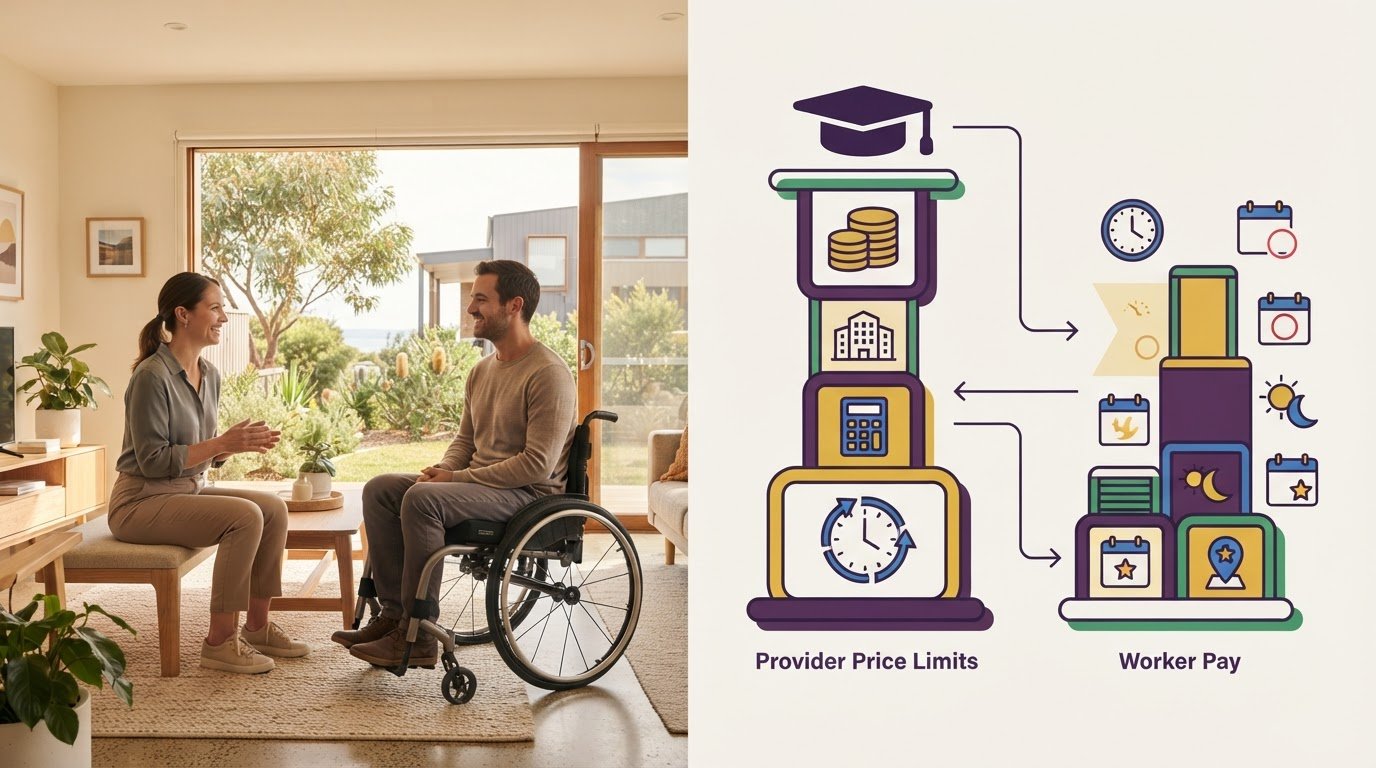
NDIS support worker hourly rates aren’t one fixed figure across Australia. The NDIS price limit is the maximum a registered provider may charge for a price-limited support. It can vary by location and the time the support is delivered.
It’s understandable to compare that figure with a worker’s pay, but they’re different amounts. The price limit isn’t the worker’s hourly wage. Pay can depend on factors such as the applicable award, employment type and shift penalties.
This guide explains how NDIS price limits and worker pay relate, why rates can differ by location, day and time, and what determines limits for other NDIS supports. You’ll also learn how to read these figures when considering the support that fits your needs.
Key Takeaways
- Separate the NDIS price limit from a support worker’s wage: they’re different amounts with different purposes.
- Compare rates by support type, location and time of day, as each can affect the applicable price limit.
- When reviewing a quote, match the support and shift details to the current NDIS pricing schedule.
- Worker pay can vary with award classification, employment type and penalties for weekend or public holiday shifts.
- Other NDIS supports have their own price limits, so the rate for one type of assistance won’t apply to every support.
Are support worker pay rates the same in all states?
No. NDIS price limits can differ depending on the support, shift and location. Remember, too, that a provider’s charge and a support worker’s wage are different amounts.
Price limits and worker wages
An NDIS price limit is the maximum a registered provider may charge for an hour of a price-limited support. It isn’t the worker’s wage. This distinction helps you read a quote without assuming the full charge goes to the person providing your support.
“MMM” refers to the Modified Monash Model, which classifies locations. Here, the stated category covers metropolitan and regional areas across Australia. The provider’s charge covers delivering the support, while the worker’s pay follows their employment arrangements.
Private support costs are agreed outside the NDIS price schedule. To compare a private charge with an NDIS-funded support, look at what the service includes and how its cost is calculated.
For supports with price limits, check the details of your quote to understand the charge. To identify the maximum, match the support item, location and shift details on your quote.
Price limits by support and shift
The applicable limit can change with the support category and when you receive support. “High-intensity” is a separate category in the pricing schedule, so check that your quote uses the category that matches your support.
For 2026-27 in metropolitan and regional areas (MMM 1-5), standard self-care limits apply nationally based on your specific geographic classification.
Location matters too. If a shift doesn’t meet a stated time-of-day rule, the higher relevant limit applies to the whole support. Check the support item, location and full shift against the current NDIS Pricing Schedule, which replaced the previous pricing arrangements from July 2026.
Managed plan rate differences
Your funding management type doesn’t set a different price limit for a support covered by the NDIS schedule. Whether you self-manage, use a plan manager or have the NDIA manage your funding, the support item, location and shift determine the relevant maximum.
The payment process does differ. If you self-manage, you handle support payments. With plan-managed funding, your plan manager processes invoices, while the NDIA manages payment for NDIA-managed funding. This changes who handles the invoice, not the applicable limit.
Saturday, Sunday and public holiday rates
When planning support on a weekend or public holiday, two figures can affect your budget: the provider’s NDIS price limit and the worker’s pay. They relate to the same shift, but they aren’t the same amount.
Weekend penalty rates
The SCHADS Award, which sets minimum employment conditions for social and community services workers, applies different pay rates to weekend shifts. If a worker is permanent, Saturday work is paid at 150% and Sunday work at 200% of their ordinary hourly rate. Casual workers receive 175% on Saturday and 225% on Sunday, including casual loading.
These are worker pay figures, not necessarily the provider’s charge. When comparing a quote, keep the worker’s wage separate from the price limit for the support.
A permanent support worker’s approximate 2026 Saturday pay is A$51.87 an hour, while Sunday pay is A$69.16. Casual Sunday pay is A$77.81 an hour. These examples show why you need to consider the employment arrangement and the shift day together.
Public holiday penalties
Public holiday work attracts a higher penalty under the SCHADS Award. If a worker is permanent, the rate is 250% of their ordinary hourly rate. For a casual worker, it’s 275%, including casual loading.
A permanent support worker’s approximate public holiday pay is A$86.45 an hour. These are examples of worker pay, not NDIS price limits. The worker’s classification and employment arrangement affect which wage figure applies.
For your budget, check the support item and shift day shown in the quote, then compare the provider’s charge with the applicable NDIS limit. Weekday, Saturday, Sunday and public holiday shifts may have different limits. Keeping the charge and worker pay separate makes it easier to understand what each figure represents.
What Sits Between the Price Limit and Worker Pay?
A quote covers more than a worker’s wage. To understand the difference, compare the amount charged with the matching support and price limit in the current NDIS Pricing Schedule, which lists support items and maximum charges.
The schedule replaced the NDIS Pricing Arrangements and Price Limits from July 2026. NDIS pricing is updated at least once a year on 1 July, so use the schedule that applies to the date of your support rather than relying on an older quote or saved rate.
As you review a quote, match these details with the schedule:
- Support item: Match the listed support to the assistance you receive.
- Location: Check whether your area is classified as remote or very remote.
- Shift: Note whether support is weekday, weekend, overnight or a sleepover.
- Intensity: Check whether the support is standard or high intensity.
- Unit: See whether the limit is hourly or charged per shift.
Location can change the maximum. Those categories are based on the Modified Monash Model (MMM), which classifies locations. “MMM 1-5” refers to the metropolitan and regional areas specified in the schedule.
Overnight support also needs the right pricing unit. An NDIS night-time sleepover is a continuous period of eight hours or more. Active overnight support is a different arrangement, so compare it with its own relevant item.
If a support shift leads into or out of a sleepover, the schedule’s IDS item refers to that shift. It must be at least four hours long. Check the shift length and schedule item when reviewing how the support is priced.
The provider charge also covers the costs of delivering support, not just worker pay. That’s why the price limit shouldn’t be treated as the worker’s hourly wage.
Match the support item, location, shift and unit on your quote with the current schedule. For example, an hourly remote daytime item and a sleepover charged per shift use different pricing units, so compare each with its matching limit.

SCHADS Award pay, casual loading and penalty rates
The SCHADS Award sets minimum pay arrangements for many social and community services employees. A worker’s classification, employment type and shift period affect their pay rate.
SCHADS Award classifications
A SCHADS classification groups roles into levels, each with different minimum hourly pay rates. The worker’s level matters because their minimum pay depends on their classification, not the NDIS price limit for a support.
Listed standard hourly ranges for Levels 3 to 5 are A$38.65-A$41.45, A$44.58-A$47.97 and A$51.00-A$53.31 respectively. Levels 6 to 8 range from A$55.72-A$58.19, A$60.27-A$62.79 and A$65.39-A$67.96.
These figures are ordinary hourly pay rates, not provider charges. They help distinguish a worker’s award minimum from the maximum a provider may charge for NDIS-funded assistance.
Pay and allowances
Pay under the SCHADS Award can include an ordinary rate, penalties and applicable allowances. Each depends on the work arrangements and shift, so the ordinary hourly rate alone may not show the full amount paid for a period.
The listed SCHADS Award wages rose by 4.75 per cent from the first full pay period on or after 1 July 2026. The new Award Final Classification Structure is stated to commence on 1 October 2027. These dates matter when comparing an older pay figure with a current one.
Allowances are separate from the NDIS price limit and an employee’s ordinary wage. The relevant allowance depends on the applicable Award terms and work circumstances. It shouldn’t be treated as an automatic addition to every shift.
Casual loading and penalty rates
Casual support workers receive a 25% loading in lieu of paid leave. Penalty rates then vary by shift, making employment type and the day worked important when comparing pay figures.
Under Award MA000100, permanent social and community services employees receive 1.5 times their ordinary rate on Saturday, twice their ordinary rate on Sunday, and 2.5 times their ordinary rate on public holidays. Casual employees receive 175% on Saturday, 225% on Sunday and 275% on public holidays, including casual loading.
Evening work can also have a different pay rate from weekday daytime work, so compare the shift period as well as the classification.
Other NDIS support types and hourly rates
NDIS price limits depend on the support category, not just the worker or time of day. Comparing another disability support rate with a self-care rate can mislead if the services have different items or pricing units.
These are separate support categories, so one figure doesn’t determine the rate for another.
Use the category that matches the support being delivered. For example, compare a counselling session with its counselling limit, not an occupational therapy or support coordination rate. The provider charge and listed maximum are also different: the limit sets the ceiling for the relevant item, while the charge is the amount billed for that support.
For travel, check whether the charge is for provider travel time or another travel-related cost. Provider travel time for therapy is capped at 50 per cent of the therapy price limit in 2026-27. This cap applies to therapy travel time; it shouldn’t be treated as the hourly limit for the therapy itself.
Support plans can include different categories. A participant might receive counselling and support coordination in the same week, but each service has its own item and limit. To understand how funding may be used, compare each planned support separately rather than combining hours under one general hourly rate.
Timing can matter, too. Depending on the category and schedule, a weekday daytime item may have different pricing rules from weekend or overnight support. Read the item description and unit alongside the time and location, then compare like with like. This helps avoid treating a professional support rate as a general disability support worker wage.
Annual updates make the schedule date part of the comparison. NDIS pricing limits are updated at least once a year on 1 July. For a quote or budget based on 2026-27 rates, use the current schedule rather than carrying forward an earlier figure.
For a practical check, write down the support name, item, unit, time and location shown in the quote. Match those details to the relevant limit, then review any travel time separately. If you’re comparing several supports, this breakdown shows which funding amount relates to each service.
Endeavour Healthcare: In-home support
Endeavour Healthcare provides support at home and in the community. If you’re looking for practical assistance with daily routines, personal care or community access, support can be tailored to what matters in your day-to-day life.
You can also receive NDIS plan support and coordination to understand how your supports fit together. This can help make sense of your options and next steps, without confusing support coordination with financial plan management.
To discuss in-home support or other support needs, contact Endeavour Healthcare or visit endeavourhc.com.au.
Choose support that fits your everyday life
Use what you’ve learned about NDIS support worker hourly rates to make your next conversation more focused. Think about the routines where support would help, what matters most to you, and how you’d like assistance to fit into your week.
With Endeavour Healthcare, you can discuss how in-home support, personal care and community access can relate to your goals. Starting with your priorities can help you explain what you’re looking for and explore practical support for you and your family.
You don’t need every detail worked out before starting the conversation. A clear picture of the support you want is a helpful first step.
Contact Endeavour Healthcare to discuss support and talk about what could work for you. Your next step can be a simple, thoughtful conversation.
Frequently Asked Questions
How much does an NDIS support worker get paid?
An NDIS support worker’s pay depends on their SCHADS Award classification, pay point, employment type and shift. That’s a wage minimum, not the amount billed to a participant. Casual loading, weekend penalties and applicable allowances can change earnings for particular shifts. Other classifications have different minimums.
How much travel or transport costs can a support worker charge?
There isn’t one universal travel charge for every support arrangement. For a support worker using their own vehicle, the travel allowance is usually around 99 cents per kilometre. That is an allowance for vehicle use, not the worker’s hourly wage. Provider travel time for therapy has a separate cap of 50 per cent of the therapy price limit in 2026-27, and that cap doesn’t set a kilometre allowance.
How does the SCHADS Award determine pay?
The SCHADS Award sets minimum pay according to an employee’s classification and employment arrangements. A worker’s pay point and whether they’re permanent or casual also matter. Shift timing can change the applicable rate: evening, Saturday, Sunday and public holiday work can attract different pay treatment. When comparing figures, identify the worker’s classification and shift first, then distinguish their wage from the provider’s charge for support.
How much do disability support workers earn?
Earnings vary with classification and employment type. These are wage ranges, not NDIS support prices. Weekend penalties or evening work can change the applicable pay rate.
How much does evening support cost?
The amount depends on the support item, location and shift period. For a worker, 2026 evening pay figures for shifts finishing after 8pm are approximately A$38.90 an hour for permanent employment and A$47.55 for casual employment. Those are worker pay figures, not the participant’s charge. To understand an NDIS quote, compare its charge with the limit for the matching support and location.
Need help understanding NDIS support costs?
Start by separating the worker’s wage from the provider’s charge, then note the support item, shift, location and billing unit on your quote. For example, an hourly support and a sleepover charged per shift aren’t directly comparable. Endeavour Healthcare’s NDIS plan support can help clarify how supports fit with your plan and funding, without confusing that guidance with financial plan management.
Need other NDIS prices?
Other support categories have their own price limits. Match the quote to the item description before comparing amounts, as these categories cover different supports. Occupational therapy, counselling and support coordination also have separate limits, rather than one rate covering every service.
Why does a Sunday shift cost the participant almost twice as much?
A Sunday shift can have a higher participant charge because its NDIS price limit differs from a weekday limit. Sunday work can also affect worker pay under the SCHADS Award. These are related costs, but they aren’t the same figure. The participant’s charge depends on the support item and the provider’s charge within the applicable limit, so a Sunday booking isn’t automatically billed at exactly twice the weekday amount.
Leave a Reply